What Makes a Parking Tile Heavy-Duty
This guide explains exactly what separates a genuinely heavy-duty parking tile from an ordinary one, and what to look for before you buy.

What Makes a Parking Tile Heavy-Duty? A Buyer's Guide
Category: Buyer's Guide
Read time: 7 min
Tags: Parking Tiles, Concrete Products, Construction Tips
Not all parking tiles are built the same. Walk into any building materials supplier and you'll find tiles marketed as "heavy-duty" — but without understanding what that actually means structurally, it's easy to end up with a surface that cracks under load, degrades within a few years, or requires constant maintenance.
This guide explains exactly what separates a genuinely heavy-duty parking tile from an ordinary one, and what to look for before you buy.
Why parking surfaces fail prematurely
Before getting into specs, it helps to understand the most common reasons parking surfaces deteriorate ahead of their expected lifespan.
Underspecified tiles are the leading cause. Tiles rated for pedestrian loads are sometimes installed in vehicle areas to cut costs — they simply weren't designed for the repeated point loading of tyres.
Poor sub-base preparation is the second biggest factor. Even high-quality tiles will crack and settle if the ground beneath hasn't been properly compacted and levelled. The tile is only as good as what's underneath it.
Water damage is a slow but reliable problem. Tiles with high water absorption rates allow moisture to penetrate the surface, weaken the bond with bedding material, and in colder regions, cause freeze-thaw cracking.
Inadequate thickness for the load type is another common error. A tile that's too thin flexes under vehicle weight, which causes cracking from the underside — often invisible until the surface begins to spall.
Understanding these failure modes tells you exactly what to look for in a heavy-duty tile.
The 4 technical specs that define a heavy-duty parking tile
1. Compressive strength
Compressive strength is the single most important specification for a parking tile. It measures how much load a tile can bear before it fractures, expressed in N/mm² (newtons per square millimetre).
Use case
Minimum recommended grade
Pedestrian-only areas
M20 (20 N/mm²)
Light vehicle parking (cars, bikes)
M30 (30 N/mm²)
Heavy vehicle areas (trucks, buses)
M40+ (40 N/mm²)
Industrial yards / logistics bays
M50+ (50 N/mm²)
A tile sold without a stated compressive strength grade should be treated with caution. Any credible manufacturer will have batch test data available.
2. Thickness
Thickness determines how well a tile distributes load across the sub-base. Thicker tiles flex less under load and resist underside cracking.
- 60mm — suitable for light car parking on a well-prepared sub-base
- 80mm — the standard for most commercial and multi-storey parking areas
- 100mm+ — required for heavy vehicles, trucks, and high-frequency commercial use
It's worth noting that thickness and compressive strength work together. An 80mm tile at M30 will outperform a 60mm tile at M40 in most real-world parking scenarios because of the additional load distribution.
3. Water absorption rate
Water absorption is expressed as a percentage of the tile's weight. The lower the absorption rate, the more resistant the tile is to moisture damage, staining, and surface degradation.
- Below 5% — good for most outdoor parking applications
- Below 3% — recommended for areas with heavy rainfall or drainage challenges
- Below 2% — ideal for covered parking, commercial facilities, and coastal areas
High-absorption tiles feel almost identical to low-absorption ones when you're buying them. The difference only shows up 2–3 years into service, when staining and surface erosion become visible.
4. Abrasion resistance
Parking surfaces take constant surface wear — tyre friction, foot traffic, vehicle turning movements, and the grit carried by tyres from the road. Abrasion resistance measures how well a tile holds up to this wear.
Look for tiles that reference IS 1237 (Indian Standards for floor tiles) or equivalent abrasion test data. Surface-hardened tiles with a power-floated or steel-trowelled finish generally perform significantly better than standard-cast surfaces under repeated tyre contact.
Tile profiles: which shape works best for parking?
Beyond the structural specs, the profile and texture of a parking tile affects both performance and safety.
Flat / plain tiles — smooth top surface, cleanest appearance, easiest to sweep and clean. Best for covered or sheltered parking where drainage is controlled. Can be slippery when wet without a surface treatment.
Chequered / anti-slip tiles — raised diamond or square pattern embossed on the surface. The most common choice for open parking lots because the raised pattern provides grip even in wet conditions and resists tyre slip during turning.
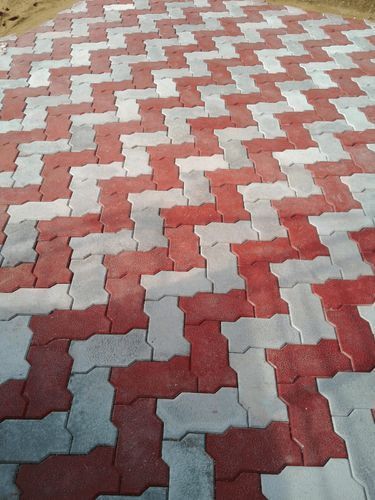
Interlocking parking tiles — shaped to lock together without mortar joints, similar to paver blocks. The interlocked surface distributes load between adjacent tiles, making them more stable under repeated vehicle movement. Easier to lift and replace individual sections if needed.
Cobble-profile tiles — a rounded raised profile, more decorative. Better suited to low-speed vehicle areas and mixed pedestrian-vehicle zones than pure parking surfaces.
For most open commercial and residential parking, chequered anti-slip tiles at 80mm, M30 grade is the practical standard.
Sub-base: the part most buyers overlook
The tile is only one component of a durable parking surface. The sub-base beneath it is equally important — and far more expensive to fix after the fact.
A properly constructed parking surface should have:
- Compacted natural subgrade — the existing earth, properly levelled and compacted to at least 95% proctor density
- Granular sub-base (GSB) — a layer of crushed stone or gravel, typically 100–150mm thick, compacted in layers
- Sand bedding layer — 25–40mm of coarse sand, screeded level, on which the tiles sit
- The tiles themselves — laid with consistent joint spacing and compacted into the bedding with a plate compactor
Skipping or skimping on the GSB layer is the most common cause of premature settlement and tile cracking — even when the tiles themselves are correctly specified.
A general rule: invest at least as much in sub-base preparation as you spend on the tiles. The two are equally responsible for the finished surface's lifespan.
Drainage: planning before you lay
Poor drainage is a slow-acting problem that eventually undermines even a well-laid parking surface. Water that pools on the surface finds its way into joints, weakens the bedding layer, and over time causes tiles to rock, settle unevenly, and crack.
A few principles worth building into your project from the start:
- Slope the surface at a minimum 1:100 gradient toward drainage channels or kerbs. This is enough to shed water without being noticeable underfoot or to drivers.
- Use open-jointed or permeable tiles in areas where direct drainage to ground is acceptable.
- Plan channel drains at low points and along boundaries before laying begins — retrofitting drainage into a finished tile surface is expensive and disruptive.
Questions to ask your supplier before ordering
Not every tile supplier will volunteer this information. These questions separate credible manufacturers from those selling on price alone.
- What is the compressive strength grade? — Get the number, not just "heavy-duty."
- What thickness are the tiles? — Confirm it matches your load requirements.
- Do you have IS certification or batch test certificates? — A quality manufacturer will have documented results.
- What is the water absorption rate? — Ask for the tested percentage, not a qualitative answer.
- What is your production lead time for bulk orders? — Important for project scheduling.
- Do you offer site delivery? — Confirm logistics capability, especially for large volumes.
A practical buying checklist
Before placing your order, confirm the following:
- [ ] Compressive strength matches your vehicle load type (M30 minimum for car parking)
- [ ] Tile thickness is appropriate (80mm standard for most commercial parking)
- [ ] Water absorption rate is documented and below 5%
- [ ] Surface profile is anti-slip for open or wet conditions
- [ ] Sub-base specification has been planned and budgeted separately
- [ ] Drainage gradient and channel placement have been designed
- [ ] Quantity includes a 10% overage for cuts and breakage
- [ ] Batch test certificate or IS certification has been requested
The bottom line
The term "heavy-duty" is used loosely in the market. What it should mean — and what you should hold your supplier to — is a specific compressive strength grade, documented thickness, low water absorption, and tested abrasion resistance.
Parking tiles are a long-term investment. A surface laid correctly with the right specification will last 20+ years with minimal maintenance. One laid with underspecified tiles on a poor sub-base will need repair or replacement within 5–7 years — often at a cost that far exceeds the original saving.
Spend time on the specification. Ask for the data. It pays off.
Need heavy-duty parking tiles for your project?
Our team can help you match the right tile specification to your site — from residential parking bays to large commercial and industrial facilities.